From February 2026 SciBar meets on the first Tuesday of the month.
See the About page for details.
We meet on the first Tuesday of the month (apart from August, when we take a summer break). Please see below for more information about the upcoming talks, and the About page for timings of all meetings, and for details of the venue and parking.
If you would like to be added to our mailing list so that you can receive monthly meeting reminders, please provide your email address via the Contact page.
UPDATE 6th May – Steve Barrett has offered some notes following the excellent talk on The ABC of Galaxy Evolution he gave on 5th May
Steve offers a copy of the slides he used. They can be downloaded here:
https://www.liv.ac.uk/~sdb/Talks/ABC-Galaxy-KnSciBar.pdf
and a video recording of the talk is here:
https://youtu.be/IP2VfhGyi8I
For those who asked about the idea of imaging a quasar receding from us at twice the speed of light, here’s a reminder of the ‘Ancient Light’ talk Steve gave via Zoom back in 2021:
Handout: https://www.liverpool.ac.uk/~sdb/Talks/Ancient-Light-KnSciBar.pdf
Recording: https://youtu.be/SX4s24SGQIE
If a galaxy is receding from us faster than the speed of light, how can the light ever reach us? A very good question. Steve hopes this Powerpoint presentation helps explain how:
https://www.liverpool.ac.uk/~sdb/Talks/Swimming-Against-Tide.pdf
Coming soon…
- 2nd June 2026 – Moor Pool Improvements
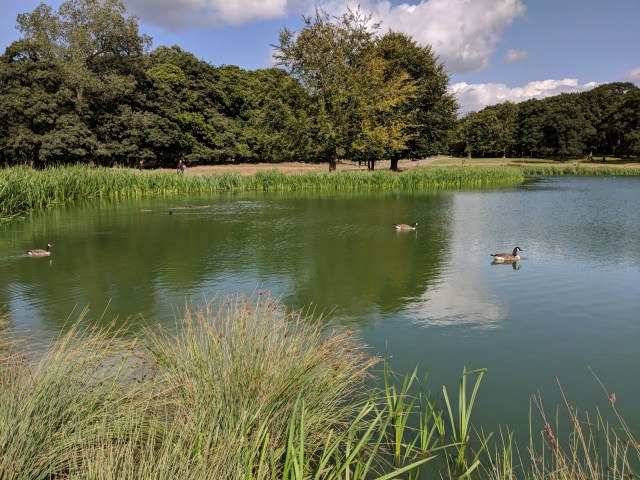
You may have seen the fish being removed from The Moor Pool or the works being undertaken at Parkgate Lane and wondered what it is all about.
Come along to hear a team from United Utilities explain how they will be improving the water quality of the Moor Pool by reducing storm overflow and connecting the Pumping Station on the Moor to the Water Treatment Works on the eastern edge of the Parkgate Industrial Estate.

Image courtesy of United Utilities - 7th July 2026 – New Molecular Shapes…
… they’re twice as odd as a Mobius strip

Representation of the electrons in the “half-Möbius”-shaped molecule
Image : IBM Research and the University of ManchesterWe may all have heard of a Mobius Strip – most simply as a looped band of paper with a twist – which only has a single side. That means that a pencil line drawn along the centre of the strip will return to the start, covering both “apparent” sides without crossing the edge.

Dr. Igor Rončević and colleagues at the University of Manchester in the UK have now discovered a molecule with an even stranger “half-Möbius” shape. A line drawn along the atoms of this molecule would take four circuits to return to its starting point.
By prodding the molecule with a small electromagnetic pulse, the team was able to modify the molecule’s twist – they could engineer its topology on demand – creating another way for chemists to manipulate molecules. Their experiment may be the first step towards a new way to engineer useful molecules by tuning their 3D shapes.
- 1st September 2026 – Nuclear in the UK; the current state of play

Professor Adrian Bull MBE is Associate Director and BNFL Chair in Nuclear Energy and Society at the Dalton Nuclear Institute, part of The University of Manchester. His focus is on Government policy around nuclear and energy, and on stakeholder and community engagement on nuclear issues.

In his talk to us, Adrian will cover 4 major areas:
– The politics, including regulatory considerations
– What is happening with small modular reactors (SMRs)
– Why other counties do nuclear better than we do
– Current prospect for nuclear in the UK - 6th October 2026 – Batting for Bats
Helen Taylor-Boyd from Keele University is a behavioural and landscape ecologist with a particular focus on the responses of wildlife to anthropogenic impact and developing practical applications in conservation. She has a passion for bats and will explain why they are so important and why their conservation is needed.

Helen says “Bats are a great example of a group of diverse and often misunderstood species; they are essential players in both human-dominated and natural environments.”
Come along to hear why Helen is “batting for bats”.